Digital media, especially the internet, have changed our lives in many ways. Thanks to mobile internet access, smartphones and tablets, media content and communication are now virtually omnipresent and constantly available. The ‘social web’ with platforms such as Instagram or TikTok, is opening up completely new forms of interaction, participation and production.
Interactive media such as video and computer games, but also new video platforms like YouTube, offer entirely new forms of media entertainment, releasing recipients from their role as passive observers and placing them in the position of actively shaping and autonomously acting users.
While new, interactive media and online communication have long taken a firm place in our daily lives, many questions about the consequences of living in a digital society remain largely unanswered: How do social and mobile media change the “rhythm” of our everyday lives?[LR1] How often does our media use conflict with other, less pleasant daily duties? And what impact do constant availability and “digital stress” have on the quality of life in the “always-on” society?
[LR1]In der deutschen Version ändern in: „Wie verändern Social und Mobile Media den „Rhythmus“ unserer Alltagslebens?“
Our research attempts to find answers to these and other questions relating to the use and impact of digital media use. In our teaching, we teach theories, concepts and empirical approaches to analyze new forms of digital media use and to sensitize our students to the individual and social implications of using new media.
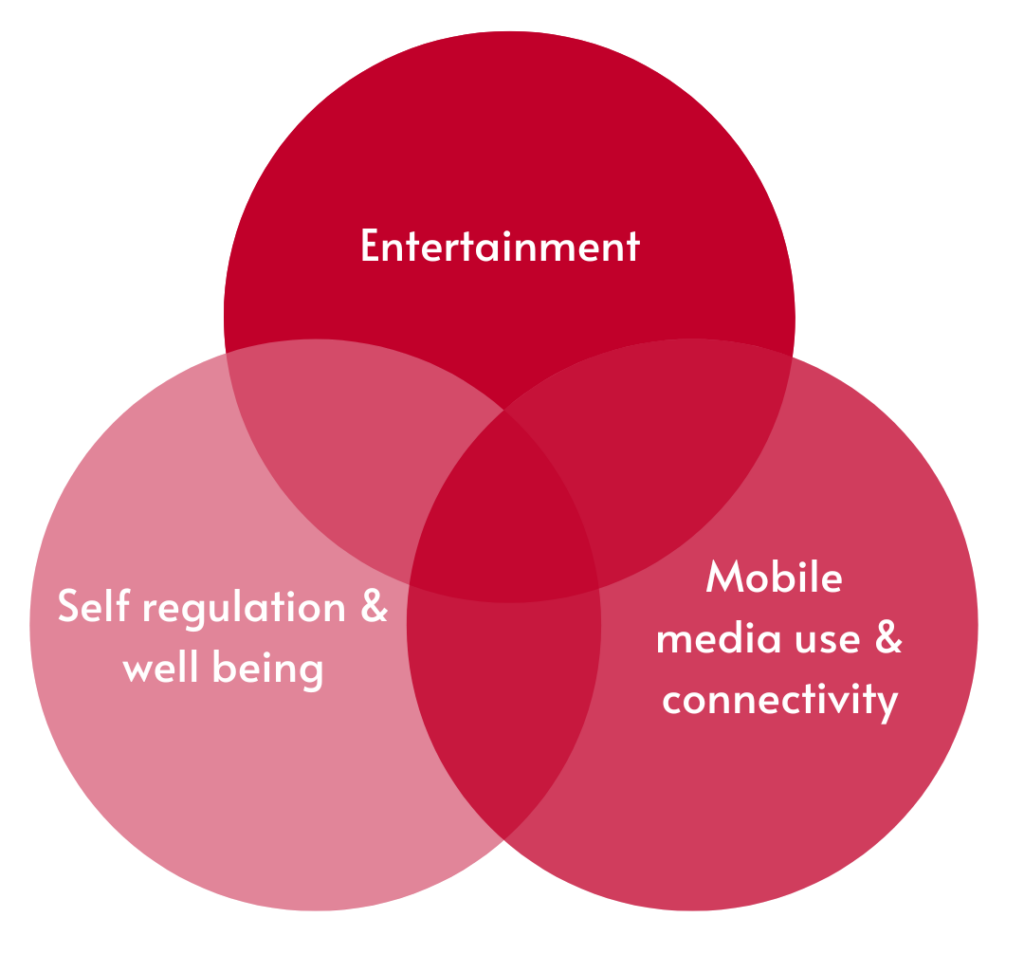
The research unit Media Effects and Media Psychology deals with questions at the interface between Communication Research and Psychology. The various research projects focus on three thematic areas: (1) entertainment research, (2) self-regulation and well-being, and (3) mobile media use and constant connectivity.
The following research questions are investigated, among others:
- How are media used to cope with stress or threatened needs?
- How are algorithms changing the experience of entertainment on platforms such as Spotify, YouTube or Netflix?
- How do smartphone users deal with constant pressure to be available?
- How does the temporary disconnection from the digital world affect well-being?
- What effects does the enjoyment of media entertainment have on the well-being or political information processing of users?
In their research programs, the team members of the research unit apply a wide range of methods, including intensive longitudinal survey designs such as experience sampling or diary studies, computational methods such as data donations or automated content analysis, experimental designs, and systematic literature reviews, while consistently adhering to open science practices.
Media are often used to cope with various types of stress. The team of the research unit addresses in various publications how certain stressors influence the selection of media entertainment and to what extent media entertainment can serve as a resource in dealing with stressors, by triggering positive emotions and role models thereby strengthening long-term resilience to stressors.
Current Publications
Kreling, R. J., Dietrich, F., Gilbert, A., & Reinecke, L. (2025). What do people watch under adversity? Testing interactions of semantic affinity and coping style using Netflix data donations. Human Communication Research. Advance online publication. https://doi.org/10.1093/hcr/hqaf019
Kreling, R. J., & Reinecke, L. (2025). Entertainment contributes to adaptive coping: A longitudinal investigation of the interplay between hedonic and eudaimonic entertainment, escapism, and meaning making. Communication Research. https://doi.org/10.1177/14614448211068104 https://doi.org/10.1177/00936502251361974
Reinecke, L., & Rieger, D. (2021). Media entertainment as a self-regulatory resource: The recovery and resilience in entertaining media use (R2EM) model. In P. Vorderer & C. Klimmt (Eds.), The Oxford Handbook of Entertainment Theory (pp. 755–779). Oxford University Press. https://doi.org/10/nwng
Increasingly, entertaining media content is no longer distributed and received in linear fashion, but on algorithmically curated platforms (e.g., YouTube, Netflix, Spotify, TikTok). This changed structure of usage situations opens up new questions about the uses and effects of entertainment media: What new challenges do media users face? What strategies do they develop to deal with these challenges? How do the experience and perception of content change during media use?
Current Publications
Dietrich, F., Ernst, A., Kreling, R., Gilbert, A., Rohr, B., Scharkow, M., & Reinecke, L. (2025). The differential effects of algorithmic recommendations on user experience: Enjoyment and serendipity in everyday music streaming. Proceedings of the 3rd International Conference of the ACM Greek SIGCHI Chapter, 8–16. https://doi.org/10/g954hw
Dietrich, F., Arenz, A., & Reinecke, L. (2024). What constitutes experiences of autonomy in digital technology use? A (computational) scoping review through the lens of self-determination theory. Interacting with Computers, iwae050. https://doi.org/10/g954jn
Ernst, A., Dietrich, F., Rohr, B., Reinecke, L., & Scharkow, M. (2024). Revisiting the digital jukebox: Applying mood management theory to algorithmically curated music streaming environments. OSF. https://doi.org/10.31234/osf.io/7eb4g
With the increasing digitalization of society, there is a growing need among many people to distance themselves from digital media from time to time and reduce their use. Digital disconnection is often said to have positive effects on psychological well-being and self-regulation. With a focus on situational methods, the research unit is working with various external partner institutions to investigate how media users evaluate digital disconnection, how they integrate it into their everyday lives and under what conditions they can actually benefit from it.
Current Publications
Gilbert, A., Klingelhoefer, J., & Meier, A. (in press). Disconnect to recharge: Well-being benefits of digital disconnection in daily life. Communication Research.
Klingelhoefer, J., Gilbert, A., & Meier, A. (2024). Momentary motivations for digital disconnection: An experience sampling study. Journal of Computer-Mediated Communication, 29(5), zmae013. https://doi.org/10.1093/jcmc/zmae013
Ross, M. Q., Gilbert, A., Klingelhoefer, J., Matassi, M., Nassen, L. M., Van Bruyssel, S., … & Parry, D. A. (2024). Mapping a pluralistic continuum of approaches to digital disconnection. Media, Culture & Society, 46(4), 851-862. https://doi.org/10.1177/01634437241228785
The Corona pandemic has impressively demonstrated that people use media to cope with threatening and stressful situations. However, media as coping instruments – in the sense of a tool for implementing specific coping strategies – already represented an important cross-sectional area in Media Psychology research in pre-pandemic times. In the research unit, together with various external partner institutions, we investigate, for example, how people successfully use (mobile) media to deal with social exclusion, or how constant pressure to be available when using smartphones affects well-being.
Current Publications
Lutz, S., Schneider, F. M., Halfmann, A., Freytag, A., & Hefner, D. (2025). Navigating social pressure to be available: The roles of mindfulness and need experiences in messenger users’ well-/ill-being. Mobile Media and Communication. https://doi.org/10.1177/14614448211068104 https://doi.org/10.1177/20501579251370458
Lutz, S., Schneider, F. M., Reich, S., Schimmel, M., Oechler, H., & Beinlich, L. (2024). Fictional friends and enemies as first aid after ostracism? Experimentally investigating the potential of para-/orthosocial relationships in belongingness need restoration and emotion regulation. Human Communication Research, 50(3), 338–353. https://doi.org/10.1093/hcr/hqae009
Schneider, F. M., Lutz, S., Halfmann, A., Meier, A., & Reinecke, L. (2022). How and when do mobile media demands impact well-being? Explicating the integrative model of mobile media use and need experiences (IM³UNE). Mobile Media and Communication, 10(2), 251–271. https://doi.org/10.1177/20501579211054928
The “entertainification of everything and everyone” sometimes leads politicians and scientists to gloomy prognoses about the future of democracy. That the so-called eudaimonic entertainment experience, in particular, can also have normatively desirable consequences when receiving various (political) media formats, has been investigated by members in diverse studies.
Current Publications
Schneider, F. M., Bartsch, A., Leonhard, L., & Meinert, A. (2025). Eudaimonic entertainment experiences of television theme nights and their relationships with political information processing and engagement. Communication Research. https://doi.org/10.1177/14614448211068104 https://doi.org/10.1177/00936502251339691
Bartsch, A., Schneider, F. M., Leonhard, L., Sukalla, F. S., & Kloss, A. (2025). The influence of eudaimonic entertainment experiences on political information processing and engagement. Communication Research, 52(5), 571–599. https://doi.org/10.1177/00936502241259921
Dietrich, F., Kugler, T., Hennings, S., Conrad, C., Schneider, F. M., & Vorderer, P. (2024). Surprised–curious–confused, empathetic, and entertained? The role of epistemic emotions and empathy in eudaimonic entertainment experiences and political news processing. Media Psychology, 27(2), 302–327. https://doi.org/10.1080/15213269.2023.2236939
If you wish to write your final thesis under the supervision of one of members of the Teaching and Research Unit Media Effects and Media Psychology, please follow the following guidelines.
Bachelor’s theses can be theoretical papers or pre-registered reports of empirical studies. Master’s theses, according to the examination regulations, are expected to be empirical studies (e.g., secondary analyses, primary data collection and analysis of this primary data).
Feel free to take a look at our current topic suggestions or the topic suggestions in the SharePoint for BA candidates.
There are different types of bachelor’s theses: theoretical papers, where literature review is paramount; pre-registered reports of empirical studies, in which you derive hypotheses and develop a research design for a study; and replication studies, in which a central study in a field of research is re-conducted, i.e., data is collected and analyzed. Which type of bachelor’s thesis you wish to choose depends on your individual interest in theory, methodology, and data analysis, as well as the topic of the bachelor’s thesis. Below you will find an overview of the types of bachelor’s theses you can write at our research group and the requirements and expectations for each.
Literature reviews aim to process and synthesize the state of research on a specific research question using existing research, thereby identifying gaps in the field of research and future research needs. Literature-based bachelor’s theses can be narrative or systematic literature reviews.
Narrative Literature Review
In a narrative literature review, the literature on a guiding research question is processed. The goal should be to bring it together and integrate it stringently and coherently. Beyond merely summarizing the theoretical and state of research, a clear theoretical contribution by the author must be evident. In this form of bachelor’s thesis, this can, for example, consist of developing a theoretical model, extending an existing model, or transferring it to a specific application context. Bringing together fields of research can also represent a clear original contribution.
Systematic Literature Review
In systematic literature reviews, the literature on a specific research question is systematically identified and summarized. Systematic literature papers therefore differ from narrative literature papers by applying concrete, predefined criteria for literature search and processing. Accordingly, this type of bachelor’s thesis is particularly suitable for students who benefit from clear structures.
The process of a systematic literature review usually includes the formulation of a research question, the systematic search for relevant programs of study using predefined keywords, the inclusion and exclusion of the literature found based on predefined criteria and a (descriptive) preparation of the results.
Example Article: Schäfer, S. (2023). Incidental news exposure in a digital media environment: a scoping review of recent research. Annals of the International Communication Association, 47(2), 242–260. https://doi.org/10.1080/23808985.2023.2169953
Students who are interested in research methods and empirical research but do not wish to implement an empirical project can leverage their strengths by writing a pre-registered report. In this theses format, students prepare an empirical study up to its implementation, without the need for data collection or evaluation. The first half of the paper involves theoretical work, processing the state of research on a specific research question and deriving hypotheses. The second half then provides an explanation of the methodological implementation of the planned study (design, measured constructs, possibly stimuli), a concluding critical discussion of the study’s limitations, and an outlook on open questions for future research.
Replication studies serve to verify the reliability and robustness of the results of a previous study. They are particularly suitable as a bachelor’s thesis for students who enjoy working with data. The first step is to identify a study to be replicated. Studies that have made materials such as questionnaires or experimental stimuli publicly accessible are particularly suitable. The corresponding study is then re-conducted and, if necessary, expanded with additional variables. The collected data are evaluated within the scope of the bachelor’s thesis and discussed in relation to the original study.
Further Information: Erdfelder, E., & Ulrich, R. (2018). Zur Methodologie von Replikationsstudien. Psychologische Rundschau, 69(1), 3–21. https://doi.org/10.1026/0033-3042/a000387
Example Article: Erdmann, E., & Dienlin, T. (2022). Binge-watching, self-determination, and well-being: A partially successful direct replication and extension of Granow et al. (2018). Journal of Media Psychology, 34(6), 383–394. https://doi.org/10.1027/1864-1105/a000334
- You can also find general information on writing final theses at the Department for Communication on the pages of the student advising office.
- For final theses in the Teaching and Research Unit Media Effects and Media Psychology, the citation style of to the APA Publication Manual, 7th edition, applies. A short manual with the most important citation rules can be found here.
- Please arrange appointments for a discussion with your supervisor in good time, as short-notice appointment scheduling is not always possible depending on the current workload of the consultation hour. Therefore, submit appointment requests with sufficient advance notice and make sure to attend supervision appointments. Please do not only come to consultation hours when you are already under extreme time pressure.
- Create a realistic schedule for when you want to have reached certain stages of your project.
- Pay attention to your well-being and regularly allow yourself time to relax. Further information and tips on time management and mental health during your program of study can be found here: https://www.me-at-jgu.de
If you would like to request supervision for your final thesis in the Teaching and Research Unit Media Effects and Media Psychology, please download the form below, fill it out accordingly, and attach it to your email.
Members of the Teaching and Research Unit of Media Effects and Media Psychology primarily supervise Bachelor’s and Master’s theses that are closely related to the research topics dealt with here. The following topics are well suited for supervision by one of our team members:
- Media psychological entertainment research
- Use and effects of video and computer games
- Processes and mechanisms of media reception (e.g., parasocial interactions, presence and flow experiences)
- Media use and psychological resilience
- Interplay of media use and psychological well-being
- Satisfaction of intrinsic basic needs in media Use (Self-Determination Theory)
- Media use, self-control, and procrastination
- Motives for and consequences of mobile internet use
- “Always-on” behavior, constant availability, and online vigilance
- Digital stress
- Social interactions and the building of social capital in online contexts
- Social comparison in online contexts
Before submitting a potential supervision request, please ensure that your topic idea aligns with the thematic focus of the research team. If this is not the case, it would be advisable to either reconsider your choice of topic or to contact another Teaching and Research Unit at the IfP when searching for a supervisor.
After successfully completing your bachelor’s or master’s thesis in the Teaching and Research Area Media Effects and Media Psychology, you must take an oral final examination. The following conditions apply:
- The examiner is usually the supervisor of your final thesis.
- The examination is an individual examination and lasts 30 minutes (for bachelor’s) or 45 minutes (for master’s).
- In the first half of the examination, the candidate briefly presents the final thesis, which is then discussed. For final oral examinations in the Mater´s Program,, please prepare a short PowerPoint presentation in which you concisely summarize the central research question, methodology, and results of your work, and which you present briefly (5 to a maximum of 10 minutes) at the beginning of the examination. For oral examinations in the Bachelor´s Program, preparing a presentation is not necessary.
- The second half of the examination is dedicated to another examination topic to be agreed upon in advance.
- After submitting your written final thesis, contact your supervisor via email.
- An overview of possible examination topics for oral examinations can be found on the right.
- Inform your supervisor of your desired topic for the oral examination. Ensure that there are no thematic overlaps between the topic you have chosen and the research question of your final thesis.
- You do not need to submit a literature list or a thesis paper for the examination topic. The examiner will provide you with a list of the relevant literature that will be the subject of the examination.
- Ask your supervisor for appointment suggestions for the oral examination. The deadline for the written evaluation of your final thesis is six weeks. The oral examination takes place no later than four weeks after the evaluation.
- As soon as an examination date has been agreed upon with your supervisor, register it with the examination office.
- Uses and Gratifications Approach and Theories of Media Selection
- Habitual Media Use
- Mood Management and Entertainment Experience
- Relationships with Media Characters: Parasocial Interactions and Identification
- Immersion in Media Worlds: Involvement, Presence, and Flow
- Satisfaction of Intrinsic Basic Needs in Media Use: Self-Determination Theory
- Permanent Connectedness and “Always On” Behavior: Media Multitasking, Communication Load, Online Vigilance
- Social Media and Mental Health
- Online Communication and the Availability of Social Capital and Social Support
- Privacy and Self-Disclosure in the Social Web
- Elaboration Likelihood Model and Persuasive Communication
- Cultivation Research
- Effects of Violent Media
- Third-Person Effect
- News Value and Gatekeeping
- Uses and Gratifications Approach and Theories of Media Selection
- Mood Management and Entertainment Experience
- Relationships with Media Characters: Parasocial Interactions, Parasocial Relationships, Affective Dispositions, and Identification
- Immersion in Media Worlds: Involvement, Presence, and Flow
- Satisfaction of Intrinsic Basic Needs in Media Use: Self-Determination Theory
- Permanent Connectedness and “Always On” Behavior: Media Multitasking,
- Communication Load, Online Vigilance, Social Media and Mental Health
- Elaboration Likelihood Model and Persuasive Communication
- Cultivation Research
- Effects of Violent Media
- The Method of Quantitative Survey in Communication Studies
- Satisfaction of Intrinsic Basic Needs in Media Use: Self-Determination Theory
- Relationships with Media Characters: Parasocial Interactions, Parasocial Relationships, Affective Dispositions, and Identification
- Immersion in Media Worlds: Involvement, Presence, and Flow
- Habitual Media Use
- Cultivation Research
- Mood Management and Entertainment Experience
- Permanent Connectedness and “Always On” Behavior
- Privacy and Self-Disclosure in Social Media
- Social Media and Mental Health
- Uses and Gratifications Approach and Theories of Media Selection
- Effects of Violent Media
- The Method of Quantitative Survey in Communication Studies
- Satisfaction of Intrinsic Basic Needs in Media Use: Self-Determination Theory
- Relationships with Media Characters: Parasocial Interactions, Parasocial Relationships, and Identification
- Immersion in Media Worlds: Involvement, Presence, and Flow
- Cultivation Research
- Mood Management and Entertainment Experience
- Online Communication and the Availability of Social Capital and Social Support
- Permanent Connectedness and “Always On” Behavior: Media Multitasking, Communication Load, Online Vigilance
- Privacy and Self-Disclosure in Social Media
- Social Media and Mental Health
- The Method of Quantitative Survey in Communication Studies
- Satisfaction of Intrinsic Basic Needs in Media Use: Self-Determination Theory
- Relationships with Media Characters: Parasocial Interactions, Parasocial Relationships, and Identification
- Immersion in Media Worlds: Involvement, Presence, and Flow
- Elaboration Likelihood Model and Persuasive Communication
- Mood Management and Entertainment Experience
- Online Communication and the Availability of Social Capital and Social Support
- Permanent Connectedness and “Always On” Behavior: Media Multitasking, Communication
- Load, Online Vigilance, Privacy and Self-Disclosure in Social Media
- Social Media and Mental Health
- The Method of Quantitative Survey in Communication Studies

